
Not every neighborhood in the Phoenix metro is a good place to flip a house. Some are priced too high to leave any margin. Others are too slow — homes sit on the market for months while your carrying costs eat into your profit. And a few are deceptively cheap but surrounded by comps that cap your ARV before you even start.
The best flip neighborhoods share a few things in common: affordable acquisition costs, strong buyer demand, room for value-add through renovation, and a track record of properties moving at or above asking price. If you know where to look, Phoenix in 2026 is full of opportunity.
We've put together this list based on current market data, investor activity, and what we're seeing on the ground across 1,700+ deals funded in the Phoenix metro. Here are the 10 best neighborhoods to flip a house in the Valley this year.
The Top 10: Phoenix Metro Flip Neighborhoods for 2026
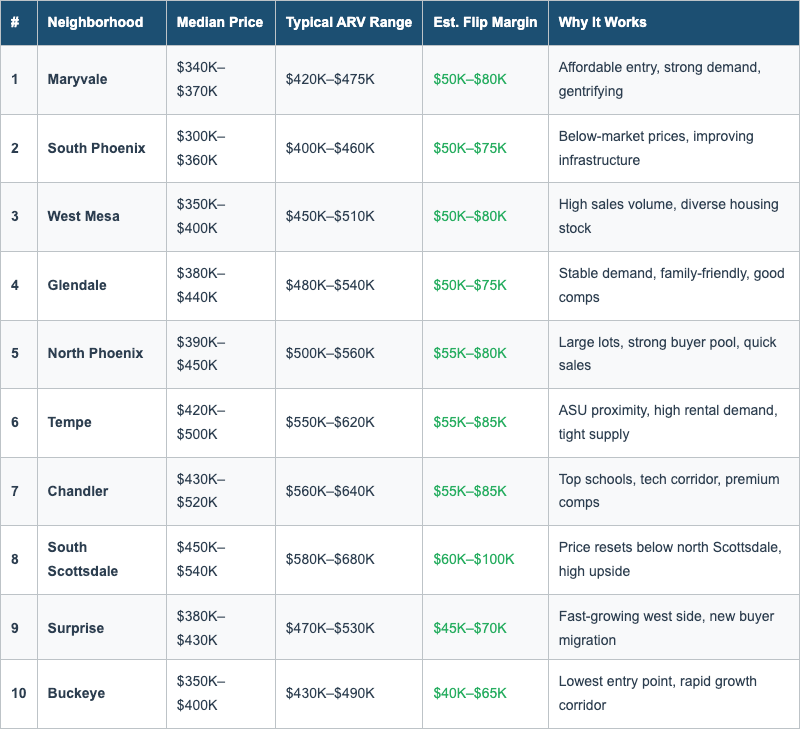
Prices reflect current 2026 market data. Flip margins are estimated gross profit (ARV minus purchase and rehab) and will vary by property condition, scope of work, and holding period.
The Deep Dive: What Makes Each Neighborhood Work
1. Maryvale — Best Entry-Level Flip Market
Maryvale offers the most affordable entry point in the Phoenix metro, with median prices in the $340K–$370K range. This historically working-class neighborhood west of downtown is actively gentrifying, with new retail, improved parks, and proximity to the I-10. Distressed properties are available below $300K, and renovated homes are selling in the $420K–$475K range. For a first-time flipper or an investor looking to stretch capital, Maryvale is hard to beat.
2. South Phoenix — Highest Upside for Value-Add Investors
South Phoenix continues to see infrastructure investment, including light rail expansion and commercial development. Median prices sit around $300K–$360K, making it one of the most affordable areas in the city. Renovated homes are selling near $400K–$460K. The key here is buying in pockets with strong comps — areas near the baseline corridor and South Mountain tend to perform best.
3. West Mesa — High Volume, Consistent Returns
Mesa is the third-largest city in Arizona, and west Mesa in particular offers a high volume of flip-ready properties. Median prices run $350K–$400K with ARVs reaching $450K–$510K on solid renovations. The diverse housing stock — everything from 1960s ranches to 1990s tract homes — means there's always inventory for investors at different experience levels.
4. Glendale — Family-Friendly with Strong Buyer Demand
Glendale's median sits around $380K–$440K, putting it in the sweet spot for investors who want slightly more margin than the entry-level neighborhoods. It's family-oriented with good schools and shopping, which means your buyer pool is deep. Renovated homes in established neighborhoods move quickly, especially when priced in the $480K–$540K range.
5. North Phoenix — Larger Lots, Strong Appreciation
North Phoenix (think the 85032, 85050, and 85054 zip codes) offers larger lots and mid-century homes that respond well to modern renovations. Median prices range from $390K–$450K, and updated homes with open floor plans and modern finishes are hitting $500K–$560K. The area benefits from proximity to the 51 freeway and Desert Ridge, making it attractive to move-up buyers.
6. Tempe — Tight Supply Meets High Demand
Tempe is a landlocked city with limited new construction, which keeps supply tight and values climbing. Median prices are $420K–$500K — higher than some neighborhoods on this list, but the demand from ASU-connected buyers, young professionals, and renters pushes ARVs to $550K–$620K. If you can find a dated property near the university or Mill Avenue, the margins are excellent.
7. Chandler — Tech Corridor Premium
Chandler commands premium prices thanks to top-rated schools, proximity to Intel, and the growing semiconductor corridor. Median prices run $430K–$520K, which requires a bigger loan, but ARVs of $560K–$640K deliver strong margins. The buyer pool is highly qualified — tech workers with solid incomes who want turnkey homes. This is a market where quality finishes pay off.
8. South Scottsdale — The Value Play in a Premium Market
North Scottsdale carries a $1M+ median, but south Scottsdale (Old Town area, 85251, 85257) offers entry points of $450K–$540K with ARVs reaching $580K–$680K. You get the Scottsdale address and school district at a fraction of the price. The dining, entertainment, and walkability of Old Town make renovated homes here extremely desirable for buyers willing to pay a premium for lifestyle.
9. Surprise — West Valley Growth Engine
Surprise has grown rapidly over the past decade, and buyers continue to migrate west for affordability. Median prices sit around $380K–$430K, and the newer housing stock means renovations tend to be cosmetic rather than structural — which keeps rehab budgets manageable. The growing retail and employment base supports strong buyer demand in the $470K–$530K ARV range.
10. Buckeye — Lowest Entry, Fastest Growth
Buckeye is one of the fastest-growing cities in the country, with median prices around $350K–$400K. The flip margins are tighter than some neighborhoods on this list ($40K–$65K gross), but the sheer volume of inventory and the pace of new development create consistent opportunity. Focus on properties near established shopping centers and schools where buyer demand is strongest.
How to Evaluate a Flip Neighborhood (Before You Buy)
A neighborhood can look great on paper and still burn you if you don't do your homework. Before committing to a deal, run through this checklist:
1. Check recent comps. Look at what renovated homes have actually sold for (not listed for) in the last 90 days within a half-mile radius. This is your real ARV — not a Zillow estimate.
2. Study days on market. If updated homes in the neighborhood are sitting for 90+ days, be cautious. Ideally you want areas where renovated properties move in 30–60 days.
3. Drive the neighborhood. Are there other renovations happening? New businesses opening? Signs of pride of ownership? Active investment is a positive signal. Boarded-up houses and vacant lots are a yellow flag.
4. Understand the buyer profile. Who's buying in this area? First-time homebuyers? Move-up families? Investors? Knowing your end buyer helps you choose the right finishes and price point.
5. Factor in carrying costs. On a $300,000 loan at 12%, you're paying $3,000/month in interest alone. If your flip takes 6 months, that's $18,000 in interest. Make sure your margin can absorb it.
Putting It Together: A Real Deal Example
Here's what a typical flip looks like in one of our top neighborhoods, using the kind of deal we fund every week at Kayak Capital:
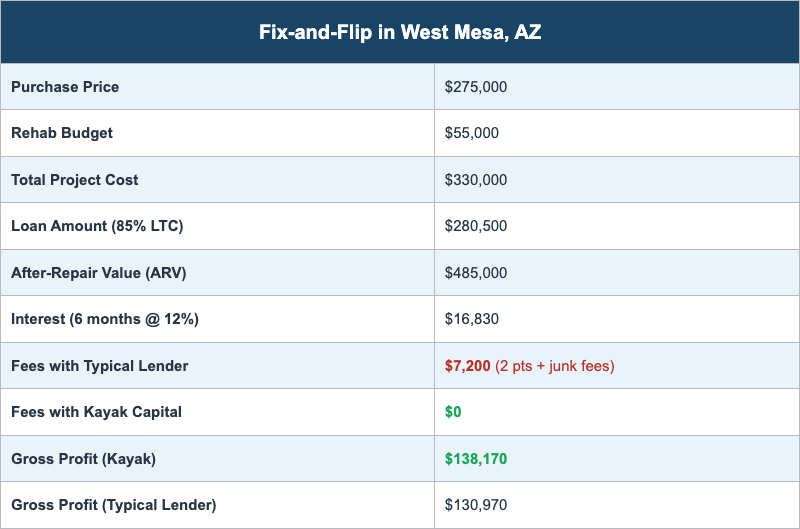
That's $7,200 more in your pocket with Kayak Capital's zero-fee model — on every single deal. Do that four times a year and you're keeping an extra $28,800.
Ready to Flip in Phoenix's Best Neighborhoods?
At Kayak Capital, we've funded over 1,700 fix-and-flip deals across every neighborhood on this list — and dozens more throughout the Phoenix metro. We know these markets inside and out, and we're here to help you move fast when the right deal comes along. No points. No fees. Just the interest rate.
Here's how to get started:
- Call us at (480) 256-2274 — talk directly to a decision-maker, not a call center.
- Apply online in under 3 minutes at KayakCapital.com.
- Get approved within 1 hour and close as fast as your title company can get the docs ready.
Your next flip is out there. Let's fund it.
Related Posts Recently Purchased